Research
Research Vision
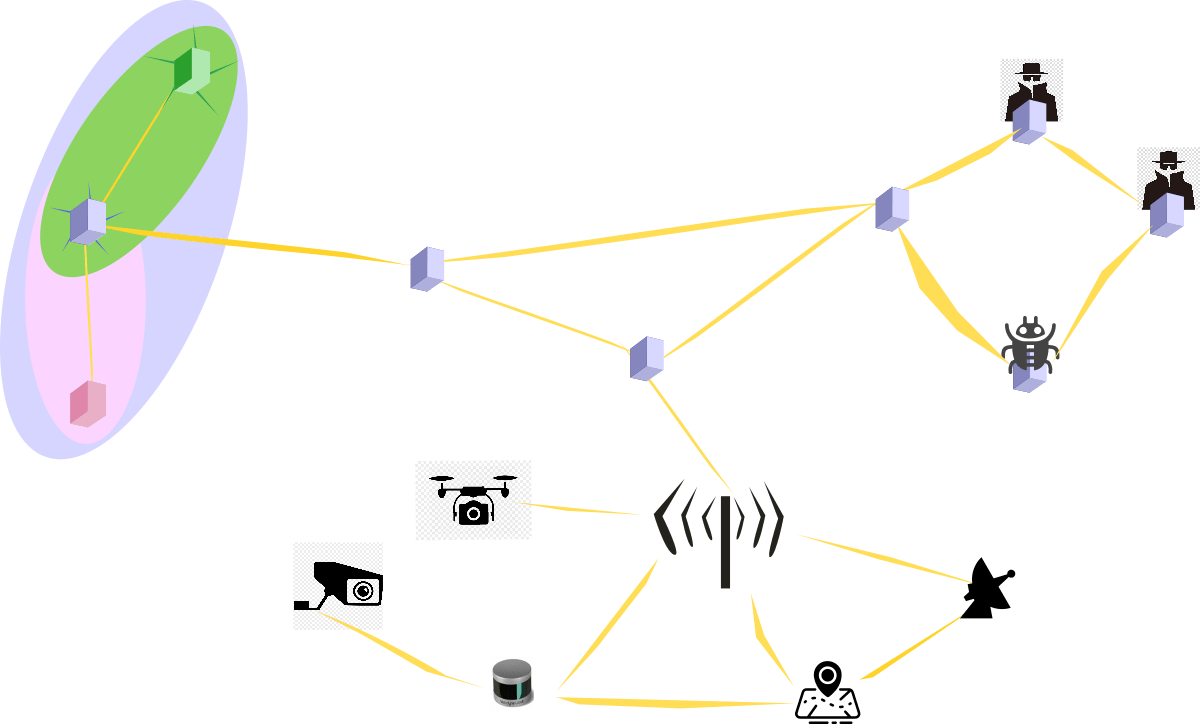
My research focuses on the theory and algorithms required for scalable, context-aware, and resilient inference in networked autonomous and mission-critical systems. I work at the intersection of networked systems, probabilistic inference, and control theory, with applications to multi-robot autonomy, sensing, and secure distributed learning.
Core themes include:
Scalability - Distributed inference over large networks under storage and communication limits.
Heterogeneity - Integrating diverse sensing modalities and non-conjugate likelihoods.
Resilience - Robustness to noise and context changes, and mitigating adversarial behavior.
 |
Storage and Communication Scalability
Goal: Design distributed Bayesian estimation algorithms that remain scalable in storage and communication while
providing rigorous performance guarantees.
Representative questions:
Relevance: How can agents identify and maintain ‘‘relevant’’ model parameters and perform provably correct real-time estimation using only locally held data?
Agreement: How can we enforce accuracy and consensus on overlapping parameter sets across agents?
Operational: How can we obtain meaningful accuracy guarantees for real-world sensors with non-conjugate measurement models?
Key ideas and results:
Formulation of marginal-consensus constrained distributed Bayesian inference, where each agent maintains local probability distributions that are consistent on shared variables.
Provably correct online estimation of optimal probability distributions using local likelihoods and networked communication.
Exponential convergence guarantees for shared variables over time-varying networks via:
Variational-inference based distributed updates.
Particle-filter adaptations for nonlinear / non-Gaussian settings.
Functional convergence to divergence neighborhoods of the true distribution, including explicit Kullback-Leibler divergence bounds.
Connected network assignment strategies that maximize information gained from distributed observations.
Relevant Publications:
Distributed Bayesian Estimation in Sensor Networks: Consensus on Marginal Densities.
Parth Paritosh, Nikolay Atanasov and Sonia Martinez
IEEE Transactions on Network Science and Engineering, 2025 [arXiv] [PDF] [Xplore] [DOI]Distributed Bayesian Estimation of Continuous Variables Over Time-Varying Directed Networks
Parth Paritosh, Nikolay Atanasov and Sonia Martinez
IEEE Control Systems Letters, 2022 [PDF] [Code Capsule] [Slides] [DOI]
Context-Aware Heterogeneous Sensing
Goal: Enable real-time inference in systems with heterogeneous sensors and changing environments through joint model learning and probabilistic estimation.
Representative questions:
Heterogeneity: How can we design online estimation algorithms for non-conjugate likelihood models across different sensing modalities?
Context: How can algorithms adapt to diverse environments via concurrent model learning and inference?
Key ideas and results:
A distributed evidence lower bound (ELBO) formulation enabling collaborative posterior approximation.
Approximate Gaussian posterior updates for non-conjugate likelihoods, leading to tractable distributed supervised-learning rules.
Normalizing-flow based context-change detection, enabling adaptation to changing environments (ongoing).
Application example:
Real-time occupancy prediction using LiDAR-equipped TurtleBots in a partitioned hall.
The system predicts occupancy probabilities across regions, demonstrating heterogeneous sensor fusion.
Relevant Publications:
Distributed Variational Inference for Online Supervised Learning
Parth Paritosh, Nikolay Atanasov and Sonia Martinez
IEEE Transactions on Control of Network Systems, 2025 [PDF] [arXiv] [Code] [Xplore] [DOI]
Presented at 2025 IEEE Conference on Decision and Control (CDC) [Slides]The Effect of the Prior on Asymptotic Performance of Uncertain Naive Bayesian Networks
Lance Kaplan, James Z. Hare and Parth Paritosh
2025 International Conference on Information Fusion (ICIF) [Xplore] [DOI]
Privacy and Resilience in Distributed Inference
Goal: Develop distributed algorithms that are both privacy-preserving and resilient to adversarial behavior, while retaining strong convergence guarantees.
Representative questions:
Privacy: How can agents preserve the confidentiality of local signals and parameters necessary for real-time second-order estimation?
Resilience: How can algorithms maintain accurate tracking in the presence of malicious data injection?
Resilient Design: How to design network structure to ensure privacy and resilience?
Key ideas and results:
Development of privacy attack models tailored to convergent distributed signals, avoiding potential leakage.
A privacy-preserving state decomposition algorithm for dynamic average consensus and related estimation tasks:
Avoids heavy encryption and is computationally efficient.
Preserves the convergence rate of non-private algorithms.
Local detection and mitigation of malicious agents through consistency monitoring and robust update rules (ongoing).
Applications:
Distributed private averaging, consensus, and optimization.
Networked autonomous systems requiring confidentiality in mission-critical settings.
Relevant Publications:
Resilient Tracking with Strongly Malicious Agents
Parth Paritosh and Lance Kaplan
Accepted at 2026 IEEE Conference on Decision and Control (CDC)Privacy-Preserving Distributed Maximum Likelihood Estimation via State Decomposition
Parth Paritosh and Lance Kaplan
IEEE Transactions on Signal Processing, 2026 [PDF] [DOI]Privacy-Preserving Convergent Dynamic Average Consensus via State Decomposition
Parth Paritosh and Lance Kaplan
2025 IEEE Statistical Signal Processing Workshop (SSP) [Xplore] [DOI]